

Karaoke Market to Reach USD 1,247.96 Million by 2035 at a 3.3% CAGR Driven by Interactive Entertainment Demand
Karaoke Market
Explore Karaoke Market trends, growth drivers, segments, regional insights, opportunities, and forecast to USD 1,247.96 million by 2035.
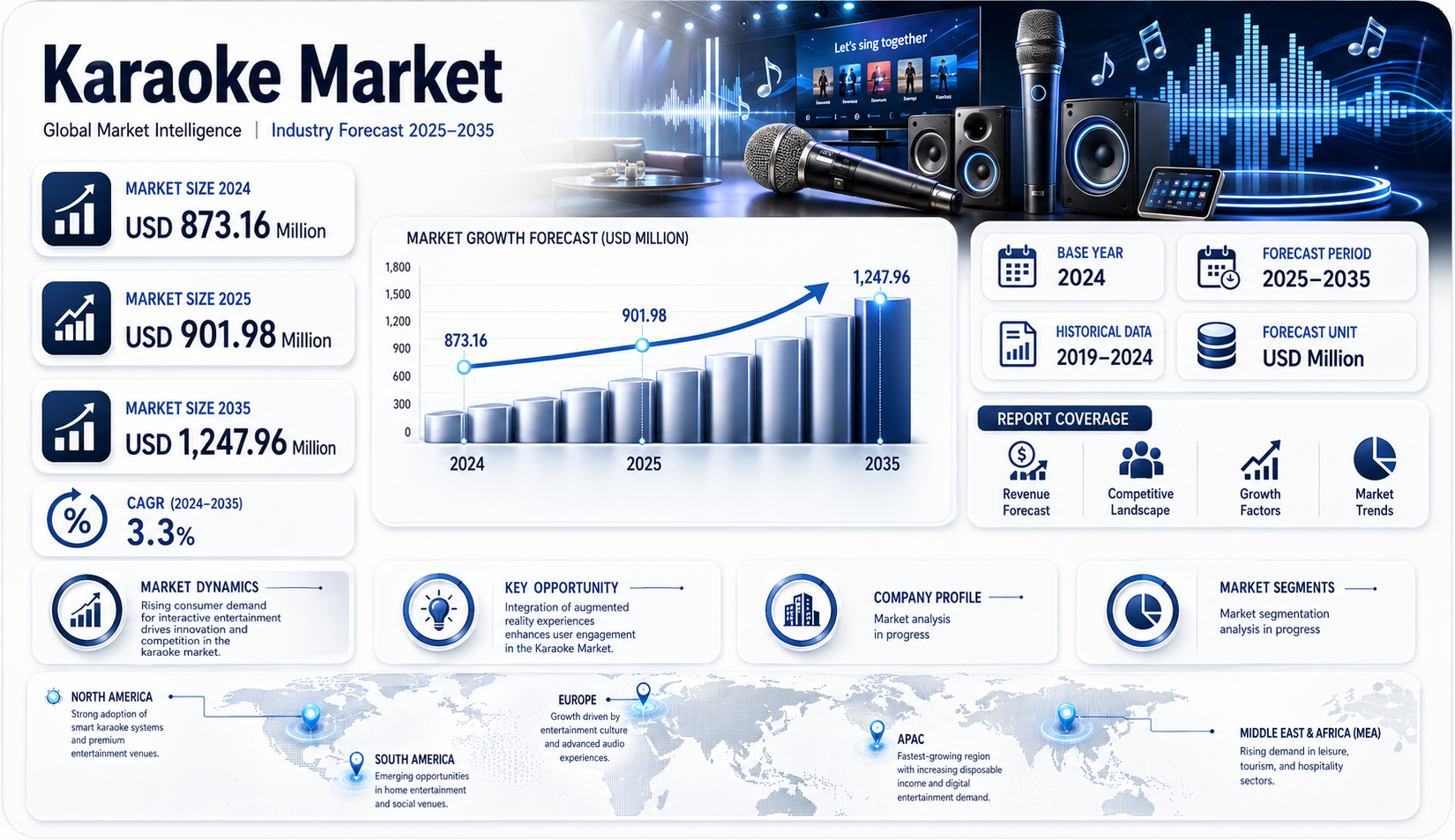
NEW YORK, NY, UNITED STATES, July 15, 2026 /EINPresswire.com/ --The global Karaoke Market is witnessing consistent growth as consumers increasingly seek engaging, social, and interactive entertainment experiences. Valued at USD 873.16 million in 2024, the market is expected to reach USD 901.98 million in 2025 and further expand to USD 1,247.96 million by 2035, registering a compound annual growth rate (CAGR) of 3.3% during the forecast period. The growing popularity of home entertainment systems, smartphone-based karaoke applications, cloud-enabled music libraries, and digital streaming technologies is reshaping the market landscape. Karaoke has evolved beyond traditional entertainment venues and has become a mainstream recreational activity across homes, cafes, restaurants, corporate events, and hospitality establishments.
The increasing adoption of connected devices and high-speed internet has significantly transformed the karaoke ecosystem. Consumers now enjoy access to extensive song catalogs, AI-powered vocal enhancement, wireless microphones, and smart karaoke systems that offer professional-quality experiences at affordable prices. The integration of cloud platforms has enabled users to regularly update music libraries without requiring hardware upgrades, making karaoke more accessible and convenient across diverse consumer groups.
Free Sample Copy – Access A Complimentary Copy of Our Report to Explore Its Content and Insights
https://www.marketresearchfuture.com/sample_request/8034
The competitive landscape of the Karaoke Market continues to evolve as companies focus on product innovation, software development, digital content expansion, and strategic collaborations. Manufacturers are investing in smart karaoke machines equipped with touchscreens, AI-assisted vocal correction, Bluetooth connectivity, and streaming platform compatibility. The report also covers revenue forecasts, competitive landscape analysis, growth factors, and emerging market trends. Market analysis regarding key companies and detailed segmentation remains in progress, while industry participants continue introducing feature-rich solutions to strengthen their market presence.
One of the strongest factors supporting market expansion is the growing consumer preference for interactive entertainment. Families, friends, and businesses increasingly use karaoke as a social activity that promotes engagement and shared experiences. The popularity of reality singing competitions, social media content creation, and live streaming platforms has further encouraged consumers to invest in karaoke systems for both personal enjoyment and online performances. These evolving entertainment preferences continue to generate stable demand across developed and emerging economies.
The Karaoke Market can be analyzed across multiple product categories, each serving distinct consumer needs. Home karaoke systems represent a rapidly growing segment as affordability and compact product designs attract residential buyers. Professional karaoke equipment remains popular among commercial establishments such as karaoke bars, entertainment lounges, restaurants, hotels, and event organizers that require premium sound quality and extensive music libraries. Mobile karaoke applications have also gained remarkable traction due to widespread smartphone adoption, allowing users to sing anytime using subscription-based or freemium platforms.
From a component perspective, hardware continues to account for a significant share of the market. Wireless microphones, speakers, mixers, amplifiers, displays, and smart karaoke consoles remain essential components for creating immersive singing experiences. Meanwhile, software solutions are becoming equally important as AI-powered scoring systems, cloud-based song management, multilingual content, voice enhancement technologies, and personalized recommendations improve user engagement. Subscription-based digital services are expected to contribute steadily to recurring market revenue.
The market also demonstrates segmentation based on end users. Residential consumers continue adopting karaoke systems for home entertainment, celebrations, and family gatherings. Commercial users, including karaoke lounges, pubs, restaurants, hotels, resorts, amusement centers, and event management companies, invest in advanced systems that enhance customer experiences and increase visitor retention. Corporate organizations are also incorporating karaoke into employee engagement programs, team-building activities, and workplace entertainment events, creating additional opportunities for market expansion.
Technology continues to redefine the karaoke industry through innovations that improve accessibility and personalization. Artificial intelligence enables real-time vocal correction, automatic scoring, and customized song recommendations based on user preferences. Cloud computing supports instant access to continuously expanding music libraries, while wireless connectivity simplifies device integration. Smart televisions, tablets, smartphones, and voice-controlled assistants have further expanded karaoke accessibility, making entertainment available across multiple connected platforms.
One of the most promising opportunities within the market is the integration of augmented reality (AR) experiences. AR technologies introduce immersive visual environments, interactive stage effects, virtual audiences, and digital performance enhancements that significantly increase user engagement. These capabilities transform karaoke into an immersive entertainment experience, particularly among younger consumers seeking innovative recreational activities. As AR hardware becomes more affordable, its adoption is expected to create new revenue streams across both residential and commercial applications.
Regionally, North America remains a mature market driven by strong consumer spending on entertainment technologies, widespread adoption of smart home devices, and increasing demand for connected entertainment experiences. The presence of advanced digital infrastructure and continuous technological innovation further supports regional market growth. Commercial venues continue investing in premium karaoke systems to attract customers through unique entertainment offerings.
Europe represents another significant market where karaoke has gained popularity across hospitality establishments, music festivals, private events, and family entertainment centers. Growing tourism, urban entertainment culture, and rising disposable incomes continue supporting market expansion. Increasing demand for multilingual content and cloud-enabled karaoke solutions further strengthens regional adoption.
The Asia-Pacific (APAC) region is expected to remain the fastest-growing market throughout the forecast period. Countries including Japan, South Korea, China, and several Southeast Asian nations have deeply embedded karaoke into their entertainment culture. Rising middle-class populations, expanding digital ecosystems, growing smartphone penetration, and increasing investments in entertainment venues continue creating substantial growth opportunities. Continuous product innovation and mobile karaoke applications are expected to further accelerate regional demand.
Meanwhile, South America and the Middle East & Africa (MEA) are gradually emerging as attractive markets due to expanding urban populations, increasing youth demographics, improving internet connectivity, and growing investments in hospitality and leisure infrastructure. As disposable incomes rise and digital entertainment becomes more accessible, these regions are expected to contribute steadily to global market revenue over the coming years.
Looking ahead, the global Karaoke Market is expected to experience stable and sustainable growth through continuous technological innovation, expanding digital ecosystems, and evolving consumer entertainment preferences. Companies focusing on cloud integration, AI-enabled personalization, augmented reality experiences, and subscription-based business models are likely to strengthen their competitive positioning. As consumers increasingly seek engaging, flexible, and immersive entertainment solutions across both residential and commercial environments, the karaoke industry is well positioned to capitalize on these long-term market trends.
Frequently Asked Questions (FAQs)
Q1. What is driving the growth of the Karaoke Market?
The market is primarily driven by rising consumer demand for interactive entertainment, increasing adoption of smart karaoke systems, cloud-based music platforms, AI-powered features, expanding mobile karaoke applications, and the growing popularity of social entertainment experiences.
Q2. What is the future outlook for the Karaoke Market?
The market is projected to grow from USD 901.98 million in 2025 to USD 1,247.96 million by 2035, registering a 3.3% CAGR. Future growth will be supported by augmented reality integration, digital innovation, expanding commercial adoption, and increasing demand for connected entertainment solutions.
Read Our Related Research Report
Musical Instruments Market –
https://www.marketresearchfuture.com/reports/musical-instruments-market-21812
Entertainment Amusement Market –
https://www.marketresearchfuture.com/reports/entertainment-amusement-market-36744
Writing Marking Instrument Market –
https://www.marketresearchfuture.com/reports/writing-marking-instrument-market-36869
Electric Motors Household Appliances Market –
https://www.marketresearchfuture.com/reports/electric-motors-household-appliances-market-8414
Electronics Retailing Market –
https://www.marketresearchfuture.com/reports/electronics-retailing-market-41553
Sagar Kadam
Market Research Future
+1 628-258-0071
email us here
Legal Disclaimer:
EIN Presswire provides this news content "as is" without warranty of any kind. We do not accept any responsibility or liability for the accuracy, content, images, videos, licenses, completeness, legality, or reliability of the information contained in this article. If you have any complaints or copyright issues related to this article, kindly contact the author above.
